


Common Methods for Leakage Detection of Heat Exchanger in Sulfuric Acid Plant
2024-05-07
Once the heat exchanger of sulfuric acid plant leaks, it will cause increased energy consumption, increased cost, and large waste; heavy, it will cause a large amount of flue gas and boiler water to mix, sulfuric acid and circulating water to form a corrosive medium, which will seriously corrode the heat exchanger The body and heat exchange tube seriously affect the safe and stable operation of the equipment. At the same time, it will greatly increase the load of the device, the absorption rate will decrease, and the temperature at the outlet of the second suction tower will also increase simultaneously. With the increase of the temperature at the outlet of the tower and the decrease of the absorption rate, the acid mist entering the desulfurization device andSO2The content will also increase, the exhaust gas index is not easy to control, the emission form of white smoke is obvious, increasing the environmental protection pressure of enterprises.
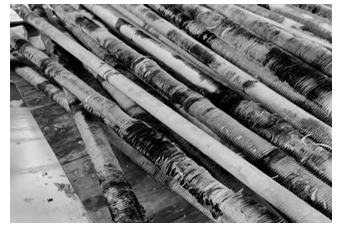
Figure1 Corrosion of inner finned tube of economizer
Common Methods for Leakage Detection of Heat Exchanger
It is extremely difficult to repair the leakage of the heat exchanger tube system, Even if such a large number of tubes are excluded, the relevant staff must take a more efficient way to check. At present, the sulfuric acid industry for heat exchanger leak detection methods are mainly the following7species.
(1) Eddy current testing. Using the principle of electromagnetic induction, the non-destructive testing method is called non-destructive testing by detecting the changes of the induced eddy current in the detected workpiece to nondestructively evaluate some properties of the conductive material and its workpiece, or find defects. In industrial production, eddy current testing is to control a variety of metal materials and a small number of non-metallic (such as graphite, carbon fiber composites, etc.) and one of the main means of product quality. Compared with other non-destructive testing methods, eddy current testing is easier to realize automation, especially for tubes, rods and wires.
(2) Penetrant inspection (surface stain inspection). The surface coloring flaw detection of the heat exchanger tube orifice weld, tube plate and heat exchanger body can detect the leakage point and defect point quickly and accurately, but the method can not detect the inner side of the flush weld such as the tube bundle tube orifice and the tube plate orifice.
(3) Shell side pressing method. Heat exchanger shell side pressure method refers to the shell side of the heat exchanger, through the injection of water pressure to detect and eliminate the possible leakage of a method, often used to detect the heat exchanger may exist in the tube sheet leakage and tube welding problems. Through the shell side pressure method of heat exchanger, the leakage problem that may exist in the shell side of heat exchanger can be effectively detected and solved, and the operation efficiency and safety of heat exchanger can be improved. When implementing this technology, it is necessary to strictly follow the operating procedures and safety requirements to avoid safety accidents.
(4) Tube pressing method. The heat exchanger tube side pressure method refers to the heat exchanger tube process, but also by injecting water pressure to detect and eliminate leakage problems of a method, commonly used to detect heat exchange tube leakage and pipe welding problems, especially for economizer heat exchanger. Its function and operation precautions are basically the same as the shell-side pressure method.
(5) Injection of colorant method. Mix the coloring agent with the pressure test water, set an injection pump at the inlet or outlet of the shell side to connect with it, and slowly inject the coloring agent into the heat exchanger through the injection pump until the pressure reaches the pressure required for the heat exchanger test. Observe heat transfer Pressure gauge and leakage of the heat exchanger. If colorant exudation occurs in the tube side or on the outer surface of the shell side, the heat exchanger has leakage problems. This method is suitable for some cases where the pressure test is unqualified due to slight leakage, especially the discovery of leakage in the middle of the plate heat exchanger plate.
(6) Macro detection method. The method is mainly aimed at heat exchangers with serpentine finned tubes and tube bundle nozzles with protective devices. Due to the special structure of the serpentine finned tube, the corrosion and rust degree of the fins can accurately reflect the state of the heat exchanger. The corrosion or corrosion of the fin tube is not only affected by the durability, the heat transfer efficiency is also greatly reduced. In addition, once the protective device of the tube bundle nozzle is found to be damaged, cracked or damaged, it must be replaced and the tube bundle nozzle must be checked to avoid deterioration of the tube bundle nozzle damage caused by the failure of the protective device.
(7) Cigarette cake method. The smoke is used to determine the location of the leak by injecting a smoke cake-like detection substance into the heat exchanger. When the smoke spreads, the smoke will leak from the leak point, and the location of the leak can be judged by observing, listening, and smelling. After determining the leak point, the medium in the tube bundle needs to be drained for repair or replacement operations. This method is suitable for the inspection of the smoke box of the heat exchanger, which can quickly and accurately determine the location of the leak point, and carry out targeted repair or replacement.
The next one-
REAL-TIME NEWS
Yangzhou Jiaming Environmental Protection Technology Co., Ltd.
Address: Fangxiang Industrial Park, Hanjiang District, Yangzhou City, Jiangsu Province
Contact: Tang Jiafu13951439212
Contact: Wu Weimin13952058396
E-mail:jmkj88@yeah.net

Scan QR Code
Copyright:Yangzhou Jiaming Environmental Protection Technology Co., Ltd.